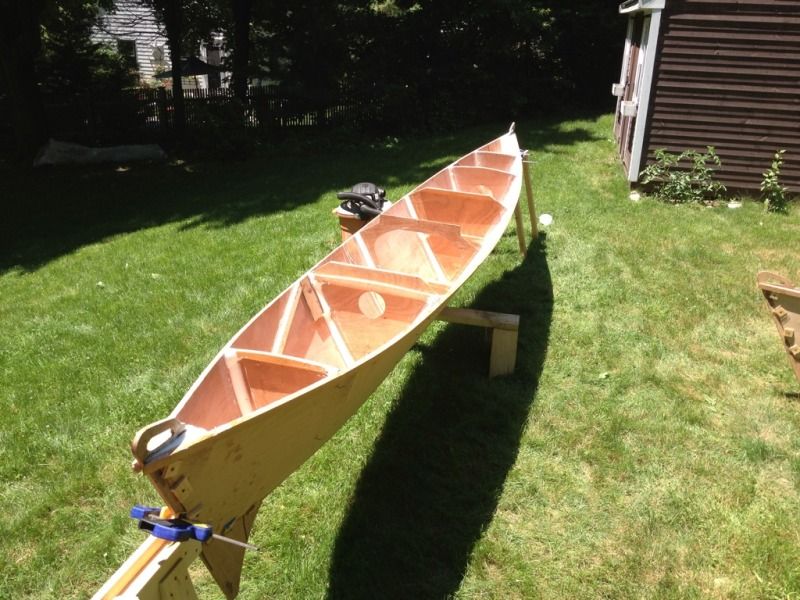
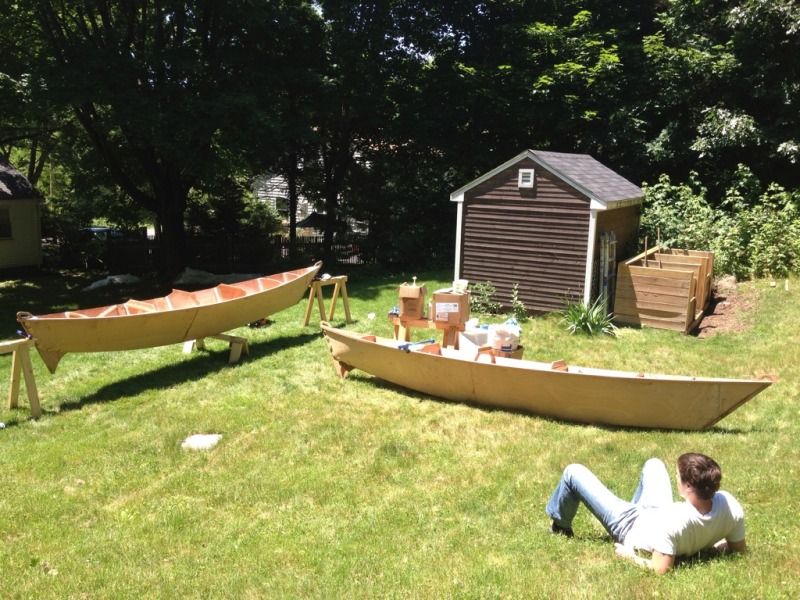
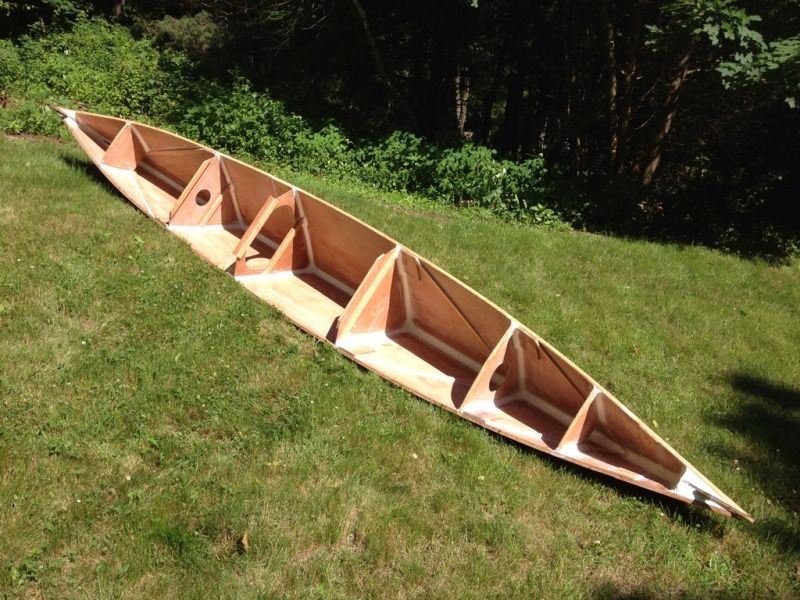
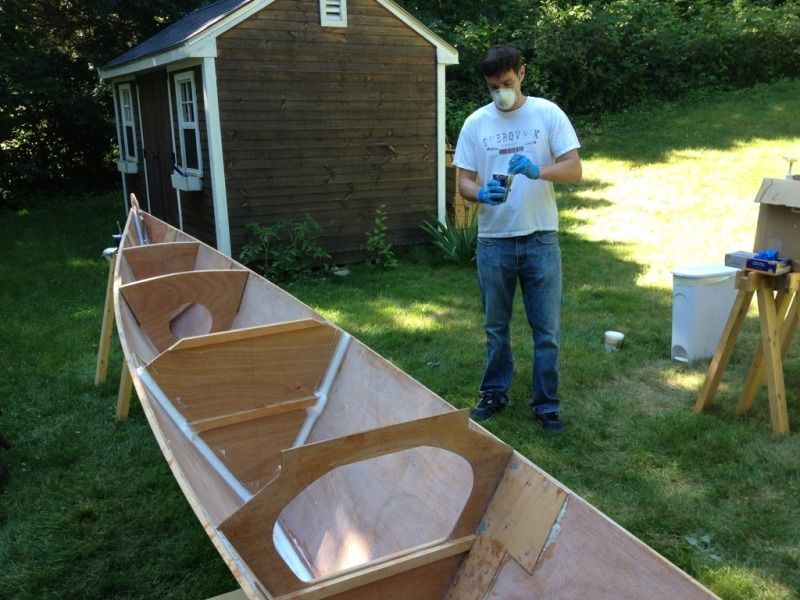
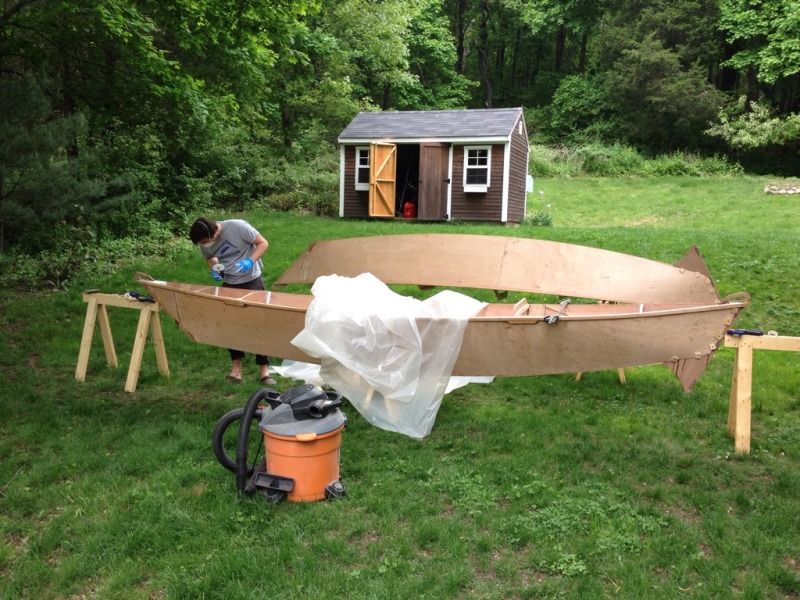
Now that the hulls are assembled they won't fit back into the basement any more. It's been ok to keep them outside so far but the sunshine won't last forever so we are moving up the fiber glassing job to protect them while they are out in the weather.
The paint job looks a bit messy up on the saw horses but all those areas won't show.
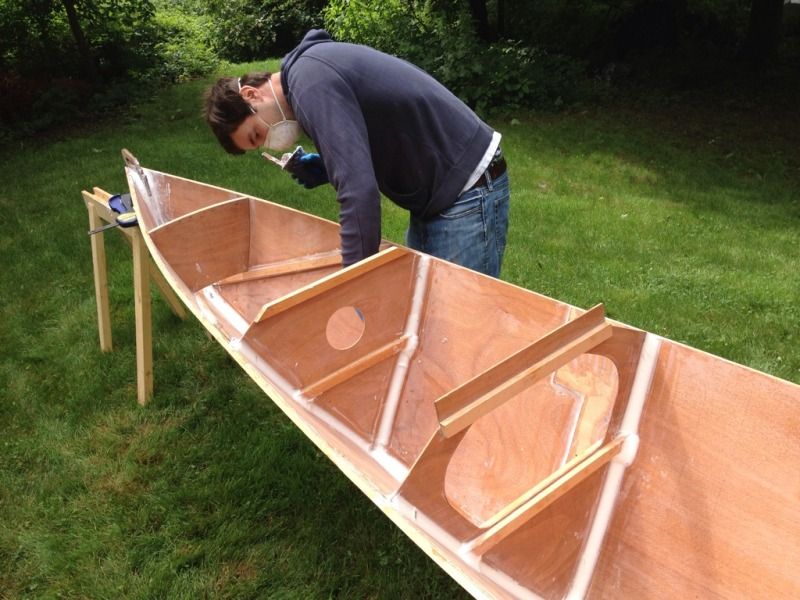
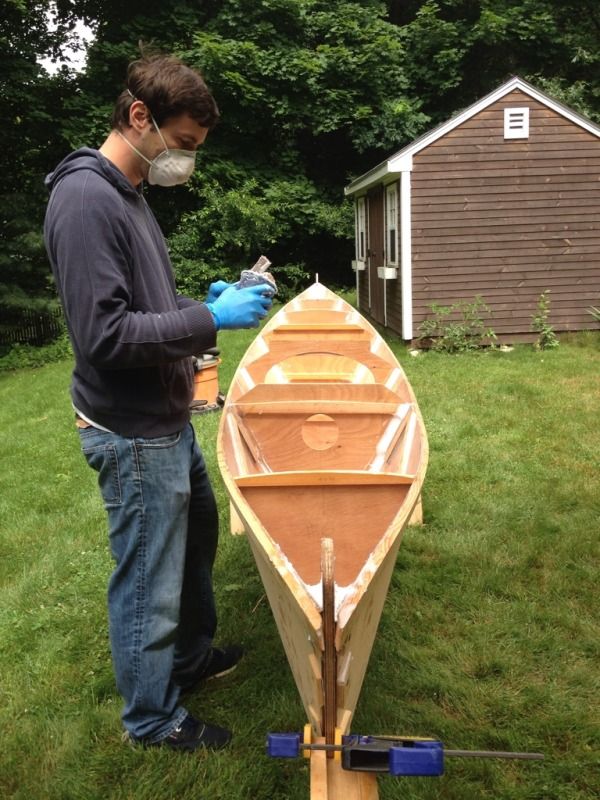
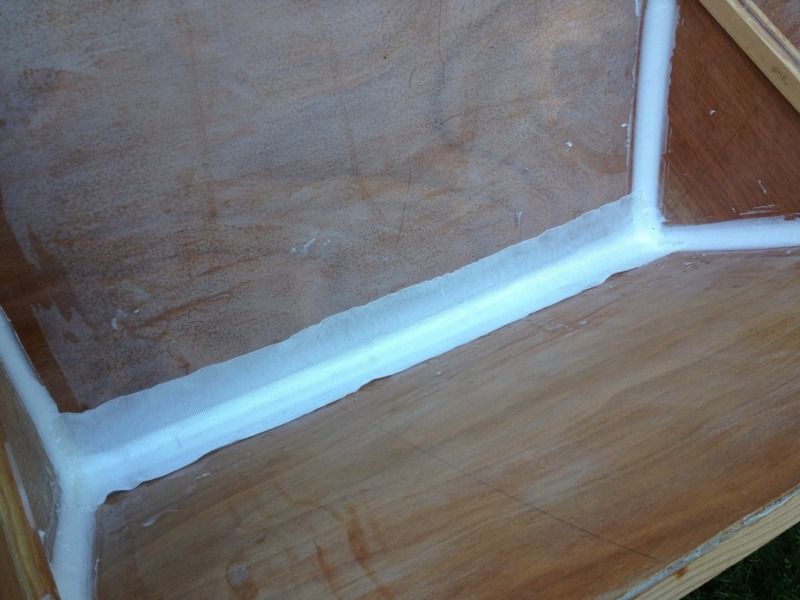
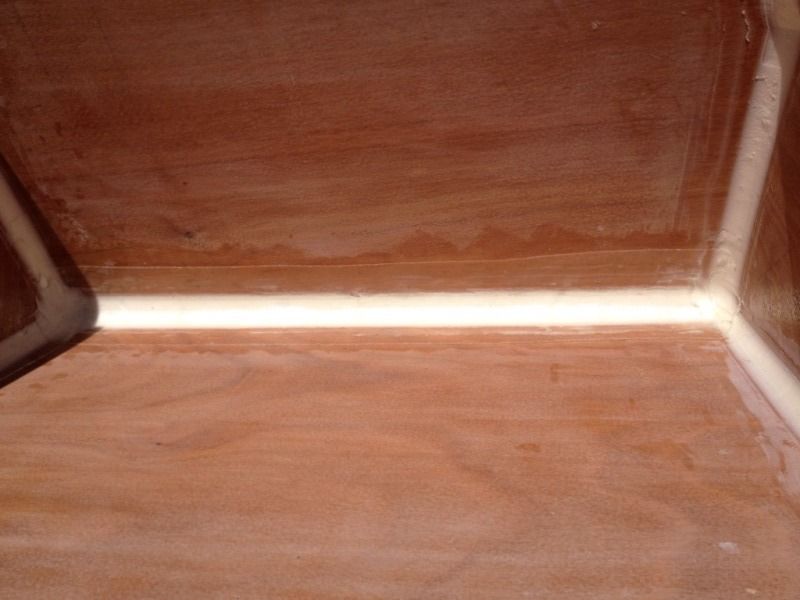
All the stitches are out and the keel has been rounded over so we can put a piece of glass tape along the keel joint. This area is going to get the most abuse pulling the boat up on beaches so it gets a triple layering of fiberglass. The first layer is this tape and then the two side pieces will overlap over keel as well. We also put a bead of epoxy down to build up the radius and add more protection to the wooden keel strip.
Next we unrolled the 4oz fiberglass over the size of the hull and tacked it in place some epoxy where we couldn't hold it with tape.
Then we finally got down to spreading on the epoxy. We had been dreading the fiber glassing job and what would happen if we messed it up but it really wasn't that bad.
The fiberglass cloth does want to wrinkle as it laps over the curved edge of the keel but we kept at it and got all the wrinkles spread out.
The fiberglass also wraps up onto the skeg and smooths out the transition. This area is probably going to require some filler and sanding later but is looking pretty good.
We also had to notch the cloth around the lash pad supports. We ended up just glassing down to the edge and trimming with a razor blade which made a pretty clean edge.
Then we just had to keep moving back between the two hull as each fiberglass job cured.
This blog will document the construction and sailing adventures of a Hitia 17 beach cruising catamaran designed by James Wharram.
Showing posts with label Epoxy. Show all posts
Wednesday, August 8, 2012
Fiber glassing the hulls
Monday, July 9, 2012
Painting and keel fairing
Building a boat involves a lot of firsts, and today was the first time we applied paint to the boat. We're using bright white Easypoxy for just about everything that isn't varnished until we sort out a final color scheme - likely white and grey. The outsides will be rolled and tipped, but for the insides we're just brushing.
The sections under the fore and aft decks is fair game for paint at this point as is the area under the seats. These are going to be too hard to get to once the decks and floors are glued on so we're painting them in advance.
We could have just left it with an epoxy coating but it seems prudent to protect the wood as well as possible in case any water works its way into the bilge. The paint is such a bright white it's hard to look at in the sunlight and kind of hard to photograph too. It should be fine for the topsides but it's giving us second thoughts about using it for the deck.
Once the paint dried a bit we flipped the hull over and started fairing around the keel to prep for fiberglassing. All the gaps around the keel are filled with thickened epoxy as well as fairing around the skeg.
The stem is also faired but we stopped short of where the rigging will attach using a heavy duty u-bolt. We put a smaller fillet at the u-bolt location to make room for the backing plates and will blend it into the rest of the stem fairing later.
The last bit of fairing was to tie the stem into the ends of the sheer stringers. Once the epoxy dries we can sand the corner down to make a nice curve.
We also used the extra bits of epoxy to fill the screw, staple and stitching holes. With a bit of sanding the hull should have a nice smooth surface for the fiberglass to lay over. We left some air bubbles in the keel fiberglassing that needed filling so it would be nice to prevent that on the hulls if we can.
The sections under the fore and aft decks is fair game for paint at this point as is the area under the seats. These are going to be too hard to get to once the decks and floors are glued on so we're painting them in advance.
We could have just left it with an epoxy coating but it seems prudent to protect the wood as well as possible in case any water works its way into the bilge. The paint is such a bright white it's hard to look at in the sunlight and kind of hard to photograph too. It should be fine for the topsides but it's giving us second thoughts about using it for the deck.
Once the paint dried a bit we flipped the hull over and started fairing around the keel to prep for fiberglassing. All the gaps around the keel are filled with thickened epoxy as well as fairing around the skeg.
The stem is also faired but we stopped short of where the rigging will attach using a heavy duty u-bolt. We put a smaller fillet at the u-bolt location to make room for the backing plates and will blend it into the rest of the stem fairing later.
The last bit of fairing was to tie the stem into the ends of the sheer stringers. Once the epoxy dries we can sand the corner down to make a nice curve.
We also used the extra bits of epoxy to fill the screw, staple and stitching holes. With a bit of sanding the hull should have a nice smooth surface for the fiberglass to lay over. We left some air bubbles in the keel fiberglassing that needed filling so it would be nice to prevent that on the hulls if we can.
Thursday, June 14, 2012
The even bigger gluing day
It's been a long time since we were able to work on the boat and it was time for a big push. The last big push only accomplished about a quarter of what we set out to do. But the days have gotten much longer and today we weren't going to stop until all the fillets were in both hulls and all the keel joints were fiber glassed.
The first hull was already half filleted, so the remaining fillets went pretty quickly. Part of the speed increase was because we moved our epoxy mixing station outside near where we were working to cut down on trips to the basement.
Before we knew it the first hull was fully filleted and ready for fiberglass.
Most of the keel joints were fresh so we were able to press in the fiberglass tape while the epoxy was the consistency of a firm gel. This made smoothing out any bumps or edges easy and let the fiberglass sit nice and smooth against the fillet without any sanding.
Then we brushed on epoxy with a 2" chip brush and worked the tape with a gloved finger like a squeegee. All in all this was much easier than we thought it would be. The only trouble was a bit of unraveling at the ends when we were a bit rough with the tape.
By lunch time the first hull was filleted and taped and curing in the sun.
So we could take a small break, looked out over our work and get psyched up for the next round. The second hull had no epoxy at all, and we had about 6 hours of daylight to finish it.
After lunch the first hull was cured enough to move off the saw horse and finish curing in the sun.
The second hull went just like the first with two exceptions. First, at the filleting stage we filled the stems in three to four passes to prevent excess heat buildup. Second, we worked one 'bay' at a time doing keel, then bulkheads and then glassed the keel. That way as we moved down the boat we left the previous segment complete. Here we have just completed the middle segment and are about to put another layer in the stems.
By the time we brushed epoxy on the last piece of fiberglass the sun was hanging low in the sky but we had reached our goal. We cleaned up our mess and called it a day.
The first hull was already half filleted, so the remaining fillets went pretty quickly. Part of the speed increase was because we moved our epoxy mixing station outside near where we were working to cut down on trips to the basement.
Before we knew it the first hull was fully filleted and ready for fiberglass.
Most of the keel joints were fresh so we were able to press in the fiberglass tape while the epoxy was the consistency of a firm gel. This made smoothing out any bumps or edges easy and let the fiberglass sit nice and smooth against the fillet without any sanding.
Then we brushed on epoxy with a 2" chip brush and worked the tape with a gloved finger like a squeegee. All in all this was much easier than we thought it would be. The only trouble was a bit of unraveling at the ends when we were a bit rough with the tape.
By lunch time the first hull was filleted and taped and curing in the sun.
So we could take a small break, looked out over our work and get psyched up for the next round. The second hull had no epoxy at all, and we had about 6 hours of daylight to finish it.
After lunch the first hull was cured enough to move off the saw horse and finish curing in the sun.
The second hull went just like the first with two exceptions. First, at the filleting stage we filled the stems in three to four passes to prevent excess heat buildup. Second, we worked one 'bay' at a time doing keel, then bulkheads and then glassed the keel. That way as we moved down the boat we left the previous segment complete. Here we have just completed the middle segment and are about to put another layer in the stems.
By the time we brushed epoxy on the last piece of fiberglass the sun was hanging low in the sky but we had reached our goal. We cleaned up our mess and called it a day.
Saturday, May 12, 2012
The big glue day - Part 2
Earlier in the day we put down two layers of epoxy around the keel and stems, the first layer raw and the next mixed to a runny consistency with milled fiberglass. These layers were to seal down in all the nooks and crannies before adding the fillets to make sure there are no voids. Now that these layers are cured and our lunch break is over it's time to get epoxying again. Doesn't look like we are going to get through both hulls like we thought and turns out we didn't even get the one hull fully filleted.
We had trouble with bugs and leaves falling out of the tree the areas we weren't currently working on were covered with plastic.
I miss read the plans when drilling out plywood fillet smoothing tools and mistook a radius for a diameter and so the first attempts at hull fillets were half the proper size. Compare the ones on the right which is what we started doing, with those on the left which are correct. Glad we caught our mistake early!
The stems take up a huge amount of epoxy to fill but end up very strong and solid. We made the mistake of applying all this fillet in one go which caused the epoxy to get very hot. In the future we will build up to thicknesses like this in multiple passes.
By the time the sun was going down we had only made it through half of one hull. Not the kind of progress we were hoping for if this boat is going to take us sailing this season.
We had trouble with bugs and leaves falling out of the tree the areas we weren't currently working on were covered with plastic.
I miss read the plans when drilling out plywood fillet smoothing tools and mistook a radius for a diameter and so the first attempts at hull fillets were half the proper size. Compare the ones on the right which is what we started doing, with those on the left which are correct. Glad we caught our mistake early!
The stems take up a huge amount of epoxy to fill but end up very strong and solid. We made the mistake of applying all this fillet in one go which caused the epoxy to get very hot. In the future we will build up to thicknesses like this in multiple passes.
By the time the sun was going down we had only made it through half of one hull. Not the kind of progress we were hoping for if this boat is going to take us sailing this season.
The big glue day - Part 1
The big day of gluing is finally here. The temperature is up and no rain in the forecast means it's time to get busy on our gluing ordeal. With any luck we can get all the rounds of gluing in one after the other in one drawn out process and then be done with it.
First the hulls need to come back out of the basement one more time and get set up at working height.
The aft stems were never stitched and so I attempted to do that while also pulling the panels into alignment. There is so much tension in the hull panels from the twisting that I couldn't get the stitches to hold so I went with screws instead which worked out much easier and pulled the hull panels in tight with the stem. This photo is after the gluing surfaces got a coat of raw epoxy to soak down into the nooks and crannies so that is where the small drips are coming from.
Now is also the time to check that everything is straight and level. With hardly any adjusting the hulls were perfectly lined up.
The gaps along the keel and stem are epoxied with a milled fiberglass and silica mix. These batches were mixed pretty loose so that they can settle into the gaps and make sure there are no voids.
More of the first glue round along the keel ...
Now we wait until this layer sets up and then the big fillets along the keel and bulkheads will follow. After the fillets dry if there is any daylight left we will epoxy in the fiberglass tape over the keel fillet.
To be continued ...
First the hulls need to come back out of the basement one more time and get set up at working height.
The aft stems were never stitched and so I attempted to do that while also pulling the panels into alignment. There is so much tension in the hull panels from the twisting that I couldn't get the stitches to hold so I went with screws instead which worked out much easier and pulled the hull panels in tight with the stem. This photo is after the gluing surfaces got a coat of raw epoxy to soak down into the nooks and crannies so that is where the small drips are coming from.
Now is also the time to check that everything is straight and level. With hardly any adjusting the hulls were perfectly lined up.
The gaps along the keel and stem are epoxied with a milled fiberglass and silica mix. These batches were mixed pretty loose so that they can settle into the gaps and make sure there are no voids.
More of the first glue round along the keel ...
Now we wait until this layer sets up and then the big fillets along the keel and bulkheads will follow. After the fillets dry if there is any daylight left we will epoxy in the fiberglass tape over the keel fillet.
To be continued ...
Friday, May 11, 2012
Attaching the mast step
Wharram seems to like interesting mast steps, and the Hitia 17 is no different. The mast as feet that lock it to the beam fore and aft and "locating chocks" that locate the base of the mast laterally. The front block also prevents the mast from rotating and the middle portion gives a curved initial contact point for the foot of the mast to hook onto as the mast is rotated up into place.
So here is the plan for the front block, I have made it a bit wider than the sketch which I think looks better and will give more epoxy surface area to prevent shearing along the glue joint.
Now the mast step doubling block and the block are epoxied on. The sequence here was fillets, doubling block then mast foot block.
The block liked to slide around particularly with the clamps on the angled faces. It took some adjusting but eventually it sat centered and flush with the top surface.
Now that the epoxy has cured it's time to make sure the proportions and shapes look right.
Overall I'd say the mast step is looking pretty good and I seem to be getting the hang of the fillets. The second round worked out much neater than the first though you can see that i need to go back and clean up some of the excess.
We're still struggling to find a free day with good weather to do the hulls, but they are poised and waiting should the opportunity arise.
So here is the plan for the front block, I have made it a bit wider than the sketch which I think looks better and will give more epoxy surface area to prevent shearing along the glue joint.
Now the mast step doubling block and the block are epoxied on. The sequence here was fillets, doubling block then mast foot block.
The block liked to slide around particularly with the clamps on the angled faces. It took some adjusting but eventually it sat centered and flush with the top surface.
Now that the epoxy has cured it's time to make sure the proportions and shapes look right.
Overall I'd say the mast step is looking pretty good and I seem to be getting the hang of the fillets. The second round worked out much neater than the first though you can see that i need to go back and clean up some of the excess.
We're still struggling to find a free day with good weather to do the hulls, but they are poised and waiting should the opportunity arise.
Thursday, May 10, 2012
Continuing on the main beam
A quick update on the main beam. The bottom was glued on and cured over night.
The compression blocks pretty much assure that it the top and bottom are parallel, though in some cases there was some room for adjustment based on small changes in the clamping location particularly on the ends.
And here is the main beam all glued up and man is this thing sturdy. I'm feeling better about these beams being the only thing keeping us out of the water.
Now we just have to keep up the sequence: glue, wait, fillet, wait, glue, wait, fillet, wait ...
The compression blocks pretty much assure that it the top and bottom are parallel, though in some cases there was some room for adjustment based on small changes in the clamping location particularly on the ends.
And here is the main beam all glued up and man is this thing sturdy. I'm feeling better about these beams being the only thing keeping us out of the water.
Now we just have to keep up the sequence: glue, wait, fillet, wait, glue, wait, fillet, wait ...
Tuesday, May 8, 2012
Starting the main beam
Today we found ourselves with a free day to spend working on the boat and then it rained non-stop. The weather is always gorgeous when one or the other of us is busy, but we can't let that stop us getting out on the water. Since we are confined to the basement we decided to work on the beams and save the hulls for another day.
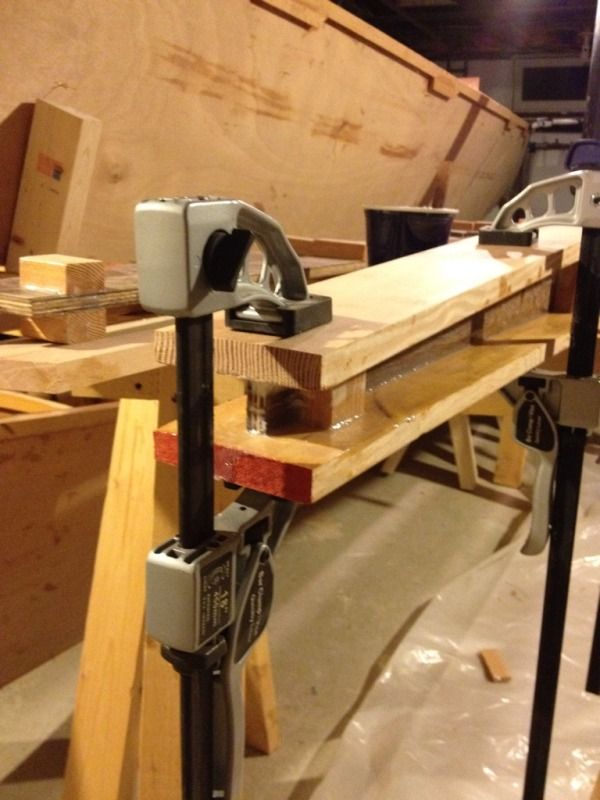
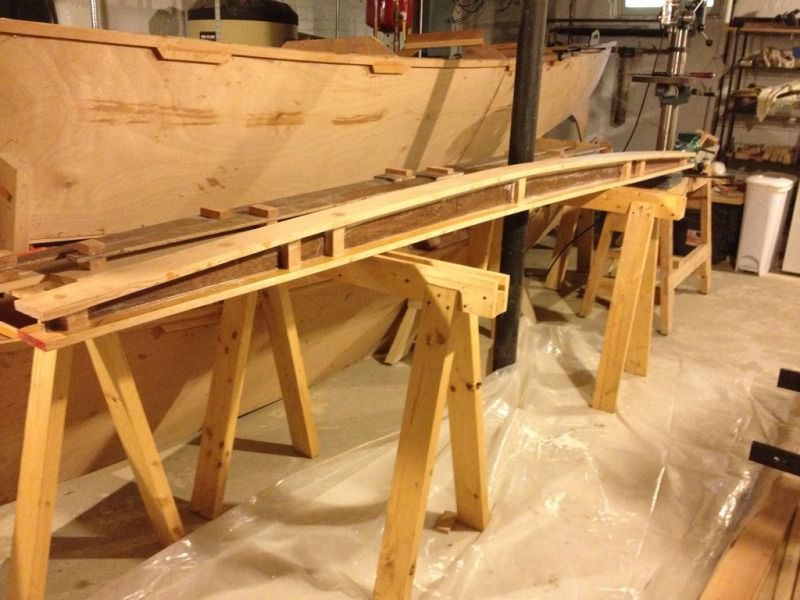
The compression support blocks were trimmed pretty close when we glued them, but needed some adjustments so that the top and bottom boards of the I-beams would sit level. We are trying to keep all of the saw dust generating activities out of the basement but it was raining so this was our compromise. The saw-rasp evened things up pretty quickly
We took advantage of a brief break in the rain to sand the epoxy coated faces of the center beam pieces. There was some concern with the metric conversions that we may have made the beams too narrow so we double checked while measuring for the top board of the main beam. It is actually an inch long which means we'll get that much more room when sailing.
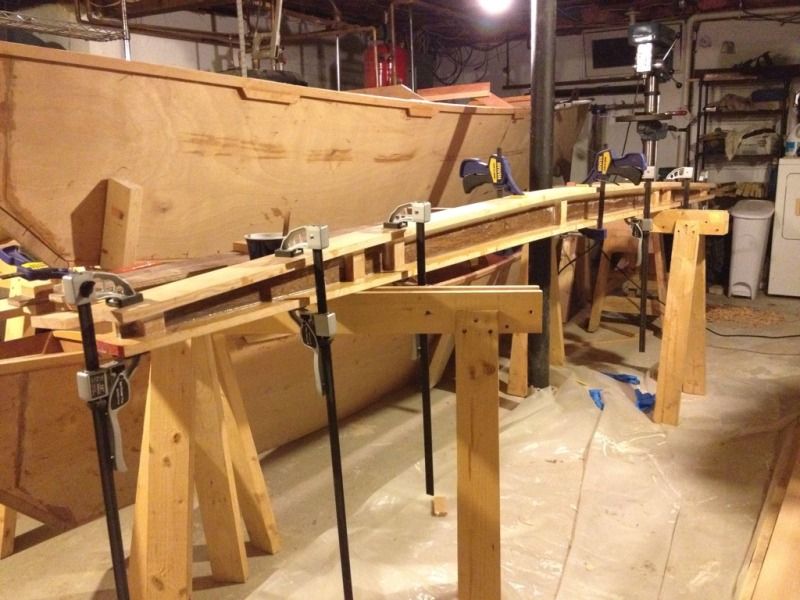
In the dry test fit it looked like we could get away with four clamps and use the stiffness of the board to close all the gaps in a fair curve.
In reality it took 7 clamps, good thing we only epoxied up one at a time! This was about the time Cam said, "If we just had more space and more clamps, think about how much we could get done!"
Sighting down the beam makes sure that the it is straight and centered. Right after this photo we adjusted the closest part a bit to the right as you can see that it is a little off.
After a few hours it was time for more fillets. Here is the glue joint smoothed out with our finger.
The middle two sections get a 1.25" radius fillet.
The outside sections step down to a 5/8" fillet which you can just see in the corner of this picture. Probably could have done the fillets once both boards are on but it seemed easier to do now while there was better access. For the next ones I'll wait till the clamps are out of the way, it's hard to keep the epoxy off of them.
One half of one beam down, can't wait for the weather to clear so we can move outdoors. That will solve the space issue, I'm not sure I'll ever have enough clamps though.
The compression support blocks were trimmed pretty close when we glued them, but needed some adjustments so that the top and bottom boards of the I-beams would sit level. We are trying to keep all of the saw dust generating activities out of the basement but it was raining so this was our compromise. The saw-rasp evened things up pretty quickly
We took advantage of a brief break in the rain to sand the epoxy coated faces of the center beam pieces. There was some concern with the metric conversions that we may have made the beams too narrow so we double checked while measuring for the top board of the main beam. It is actually an inch long which means we'll get that much more room when sailing.
In the dry test fit it looked like we could get away with four clamps and use the stiffness of the board to close all the gaps in a fair curve.
In reality it took 7 clamps, good thing we only epoxied up one at a time! This was about the time Cam said, "If we just had more space and more clamps, think about how much we could get done!"
Sighting down the beam makes sure that the it is straight and centered. Right after this photo we adjusted the closest part a bit to the right as you can see that it is a little off.
After a few hours it was time for more fillets. Here is the glue joint smoothed out with our finger.
The middle two sections get a 1.25" radius fillet.
The outside sections step down to a 5/8" fillet which you can just see in the corner of this picture. Probably could have done the fillets once both boards are on but it seemed easier to do now while there was better access. For the next ones I'll wait till the clamps are out of the way, it's hard to keep the epoxy off of them.
One half of one beam down, can't wait for the weather to clear so we can move outdoors. That will solve the space issue, I'm not sure I'll ever have enough clamps though.
Saturday, April 28, 2012
Diagonal hull stiffeners
The next step after stitching in the bulkheads is to add diagonal stiffeners to brace the thin hull panels. The diagonals go on the two fore sections and the one aft section of hull. The middle sections get their bracing from the floor structure. Here is a diagram showing the diagonal bracing in bright green and how it ties the keel and stem structure up to the sheer.
I cut each piece to fit and then made sure I had scraps the right length to use as bracing. Everything went smoothly in the test fit so I moved on to gluing. Funny how everything seems to stop going according to plan once you slather on the epoxy.
The epoxy got rid of the stiffener to hull friction so the clamping pressure kept trying to slide the pieces up and out of the hull. Adding staples or clamps near the sheer fixed the problem. The plans call for stitching these in but we have already drilled enough holes in our hulls and the stitches wouldn't have provided enough clamping pressure anyway.
Installation started in the bow section ...
.. then the next section aft ...
... and finally the aft section.
This hull is ready for fillets! One down, one to go.
I cut each piece to fit and then made sure I had scraps the right length to use as bracing. Everything went smoothly in the test fit so I moved on to gluing. Funny how everything seems to stop going according to plan once you slather on the epoxy.
The epoxy got rid of the stiffener to hull friction so the clamping pressure kept trying to slide the pieces up and out of the hull. Adding staples or clamps near the sheer fixed the problem. The plans call for stitching these in but we have already drilled enough holes in our hulls and the stitches wouldn't have provided enough clamping pressure anyway.
Installation started in the bow section ...
.. then the next section aft ...
... and finally the aft section.
This hull is ready for fillets! One down, one to go.
Subscribe to:
Posts (Atom)