The next step after stitching in the bulkheads is to add diagonal stiffeners to brace the thin hull panels. The diagonals go on the two fore sections and the one aft section of hull. The middle sections get their bracing from the floor structure. Here is a diagram showing the diagonal bracing in bright green and how it ties the keel and stem structure up to the sheer.
I cut each piece to fit and then made sure I had scraps the right length to use as bracing. Everything went smoothly in the test fit so I moved on to gluing. Funny how everything seems to stop going according to plan once you slather on the epoxy.
The epoxy got rid of the stiffener to hull friction so the clamping pressure kept trying to slide the pieces up and out of the hull. Adding staples or clamps near the sheer fixed the problem. The plans call for stitching these in but we have already drilled enough holes in our hulls and the stitches wouldn't have provided enough clamping pressure anyway.
Installation started in the bow section ...
.. then the next section aft ...
... and finally the aft section.
This hull is ready for fillets! One down, one to go.
This blog will document the construction and sailing adventures of a Hitia 17 beach cruising catamaran designed by James Wharram.
Saturday, April 28, 2012
Sunday, April 22, 2012
At long last a boat
Yesterday was the most gratifying build day yet, we can finally see the shape of one of the hulls! We have put so many hours into the pieces and prep work and it is finally starting to come together. We wanted to stitch the bulkheads into both hulls but ran out of both time and copper wire so this is all for now.
The shape is surprisingly sophisticated for a v-bottomed canoe. The flat edge of the hull panel transforms into a nice sheer line with a sharp entry and curved aft sections.
The last bulkhead was the most difficult to fit. There is a lot of curve in the plywood hulls and a lot of tension getting the bulkhead into place. The stitching holes in the bulkheads are offset ~1/2" above the hull stitching holes which pulls the bulkhead down into the hull as the stitches are tightened.
Here is a view from the stern. The clamp is distorting the shape of the sheer a bit but we'll fix that when the stern stem stitches are in.
Now it finally looks like a boat!
Stitching took longer than we though (like everything else so far on this boat!) so the second hull will have to wait for another day.
With no real work left to do we held up one of the unfinished beams so we could stand in the right spots and imagined laying out on the deck, sails set cruising the Boston harbor islands, the Cape and beyond.
The shape is surprisingly sophisticated for a v-bottomed canoe. The flat edge of the hull panel transforms into a nice sheer line with a sharp entry and curved aft sections.
The last bulkhead was the most difficult to fit. There is a lot of curve in the plywood hulls and a lot of tension getting the bulkhead into place. The stitching holes in the bulkheads are offset ~1/2" above the hull stitching holes which pulls the bulkhead down into the hull as the stitches are tightened.
Here is a view from the stern. The clamp is distorting the shape of the sheer a bit but we'll fix that when the stern stem stitches are in.
Now it finally looks like a boat!
Stitching took longer than we though (like everything else so far on this boat!) so the second hull will have to wait for another day.
With no real work left to do we held up one of the unfinished beams so we could stand in the right spots and imagined laying out on the deck, sails set cruising the Boston harbor islands, the Cape and beyond.
Sunday, April 15, 2012
Deck supports
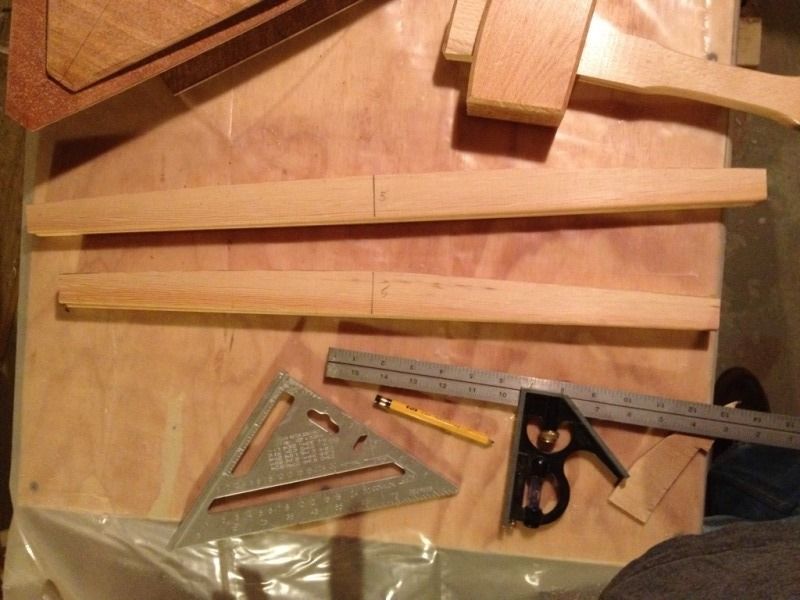
The past few weeks have been busy and distracting, but here is a small update. The last hold up for stitching the hulls were making the curved deck supports on bulkheads #3 and #5 which are the ends of the fore and aft decks.
These only took about 30 minutes to mark the curve with a batten and then clamp in the vise and plane down to the line. Score one more point for my $6 garage sale hand plane.
The tentative plan is to stitch up the hulls this week and start gluing this weekend. Let's hope life starts cooperating with our boat building schedule.
These only took about 30 minutes to mark the curve with a batten and then clamp in the vise and plane down to the line. Score one more point for my $6 garage sale hand plane.
The tentative plan is to stitch up the hulls this week and start gluing this weekend. Let's hope life starts cooperating with our boat building schedule.
Subscribe to:
Posts (Atom)